Thursday, August 27, 2015

It was bound to happen!

Last weekend, I shipped a cigar box guitar to a customer in Oregon. I really didn't want to sell it, but the buyer was persistent and so complimentary of my work that I caved in.

I've shipped dozens of guitars and amps all over the globe, by USPS Priority Mail, without a single mishap.  So, when asked by the postal clerk if I want insurance, my first reaction was, "Naw, I've shipped these things to the far reaches of the planet without a problem."  She said, "You sure?" Once again, I caved and bought insurance.

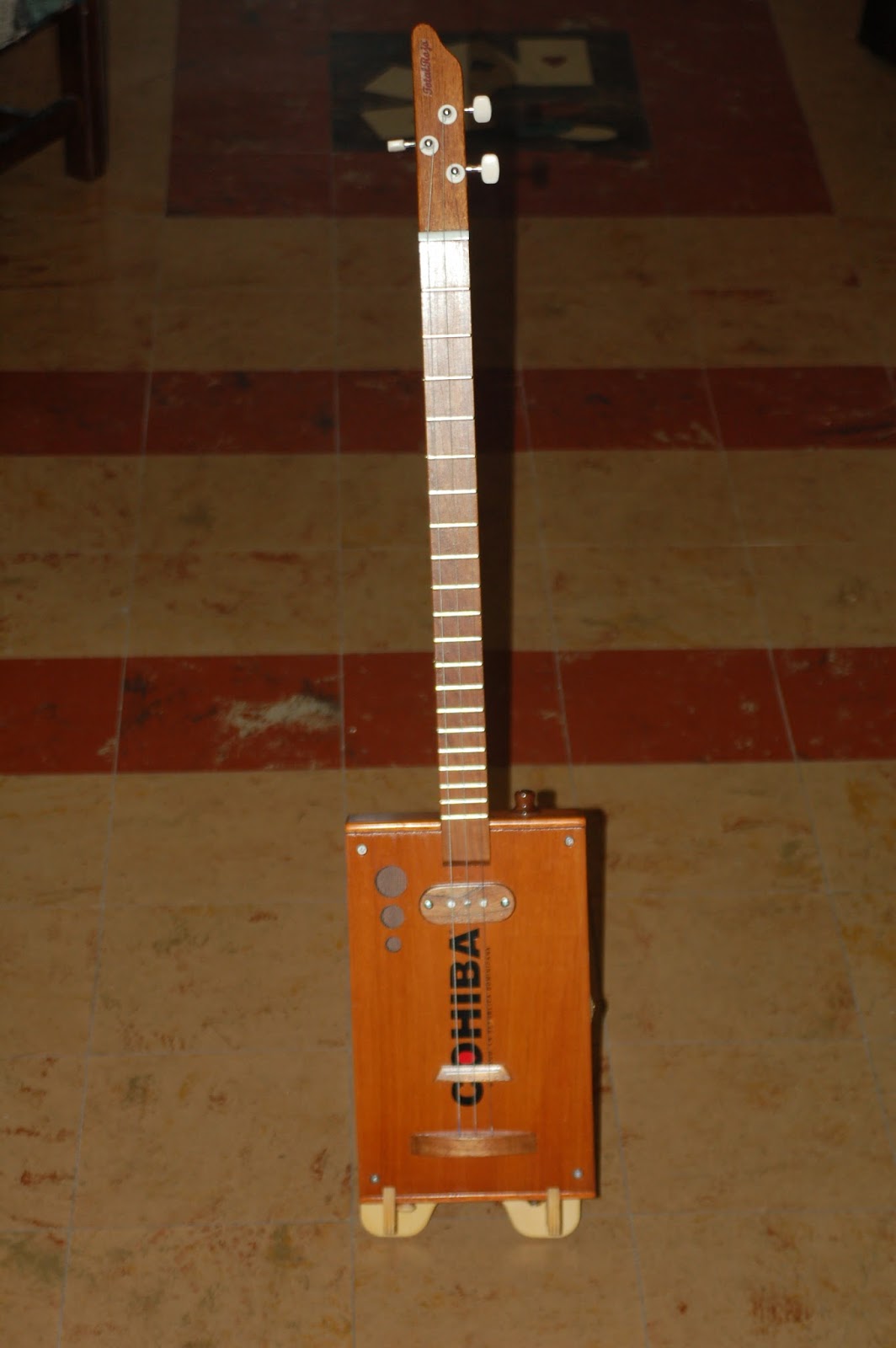
This is a photo of 'Sweetness', the three-string guitar. . . the one I should have left hanging on the wall.  I especially liked it, because the Cohiba box produces a great sound acoustically, and the handwound TotalRojo magnetic pickup gave it a rich and brilliant voice through my amp.  And, it looked good and felt good to play.


This is how the guitar arrived at its Oregon destination.


I was careful to wrap the guitar in bubble wrap and to fill the box with 'peanuts', and to attach 'fragile' stickers on all sides.  I guess I should have included stickers that said, "Please don't run over this box with your Gawddamn truck!"

Oh, well, I'll now wait to see if the insurance coverage works.

Wednesday, April 29, 2015

Let Me Introduce 'Fiorella'

'Fiorella', little flower, at least that is what my Italian guide says she is, just left my shop.


She is a dreadnought acoustic guitar built on the same platform as the other dreads I've created.

The body is exotic bocote wood sides and back with sitka spruce top and African mahogany binding. Internally, 'x' bracing is spruce. Mahogany 14-fret neck with pearl inlay position markers. Custom multi-wood headstock overlay with recessed tuner nut pockets and embossed 'T'; soundhole rosette; tailpiece inlay, heel cap and back accents; and special flower-design wood inlay at the base of the top. The bridge is polished rosewood with corian saddle, and abalone inlayed ebony bridge pins. Grover tuners tension Martin Marquis strings over a corian nut.


The headstock overlay is designed with eight specially hand fitted pieces of exotic wood (rosewood, zebrawood, yellowheart, wqalnut purpleheart, redheart, and mahogany).


The soundhole rosette is also a custom design of nineteen specially hand-shaped pieces of exotic wood (zebrawood, rosewood, walnut, bocotte, purpleheart, yellowheart, redheart, maple, ovangkol, bloodwood, and mahogany).


This photo of the back shows the unique grain of the bocotte wood.


The heel cap and extension inlay are also created from individual pieces of exotic wood.


The exotic wood inlay at the bottom of the back matches up with the end cap inlay, which also matches up with the position of the inlay at the base of the top.

Ebony end pin with abalone inlay.


And, finally, the 'little flower' rose inlay, which is created from twenty-one individual pieces of exotic wood glued together into one piece, appears to be inserted into the top of a vase created from rosewood and purpleheart.


Guitar Building is a Real Learning Experience

I've learned so much since embarking on this
guitar building journey in 2010.

It started with browsing through a magazine on a lazy day, wondering what I would do next.

I'd renovated our newly acquired 69-year-old home, so that project was rapidly winding down.

Don't get me wrong, I have never been short on hobbies (distractions), but I do get bored occasionally doing the same thing.

My hotrod building days were over. I gave the '55 Chevy to my son Jay, and the '27 Model T Ford pickup to son Joe. All the specialty tools and unusual parts were sold quickly in a 'gear head' yard sale.  Lying under a rig wrenching on it isn't for an old guy, especially not this old guy.  I didn't realize I belonged to such a rabid group, but hotrod fanatics don't hesitate to load up the goodies and geegaws.  The first guy to show up bought $1200 bucks worth of Muncie tranny parts, and it got better as the day rolled on.

Painting duck decoys is a lot of fun, but after while I ran out of carved species blanks, and I do not like to duplicate original artwork.  So, I moved on to flatwork to hang on the wall . . . for a while.

Sixty years of pinstriping cars, motorcycles, jackets and old milk cans had produced some really interesting adventures, and I met a lot of cool rod & custom builders, too.  I still keep my hand limber, 'cause I never know when a guitar creation will need a little paint slung at it.

Yup, it's been a real learning experience, this new guitar building adventure.

After reading the short blurb about the wonder of creating playable guitars from cigar boxes, I was hooked. I had to research this. I like doing artsy-fartsy stuff and I like music, so off I went to the electronic library - Google.  What I discovered was incredible and the creative examples I discovered on CigarBoxNation, CigarBoxGuitarsAustralia, and HandmadeMusicClubhouse stimulated in me a desire to proceed.

Off I went to visit my local cigar officianodo, Suzy Soprano, the owner of City News.  Oh, ya, she had just the ticket, an empty Arturo Fuente Hemingway cigar box. Oh, man, I'm in business! The box hinges were on the wrong side for this to work, but that was soon fixed.  I won't bore you with details here, just search this site for the first guitar I built and you're there.


I've just finished number 100 . . . five years later.  It's not a CBG (cigar box guitar), it's a full size dreadnought acoustic.

Yes, as I said, I get bored. I could never have worked in a factory pumping out the same thing every day, which is why I move around in the hobby to find a niche that works for me at the time.

 So, what have I learned, really?

I've learned that I can build a very nice looking and great sounding guitar.  As my son says, "It's art with strings" . . , which is the way I want it.

It's not been easy, I've taught myself through a lot of reading and doing. Early on, basic shop tools were all that was required to make a CBG.  Building solid body six-string guitars took a little more skill and acquired knowledge.  But, building full size acoustic guitars is a whole 'nother deal. The tools required to build a dreadnought are a major consideration -- buy or build.  I chose to build everything I could.  Not because I couldn't buy them, but because I wanted the satisfaction of creating my guitars from the ground up.  There's a little bit of me in every guitar I build. There are are posts on this site which show the tools I've made, so I won't bore you with further details.

I've learned some things about myself, as well.  I want my guitars to be individual one-of-a-kind creations. I want the wood to look like finely finished furniture, not like a slick piece of plastic dropped from a mold like a hundred others churned out of a mass-production facility in a day. I want the wood grain to show and the oil finish to have the aroma of a hand produced piece. I want the shape of the headstock to match the end of the fretboard and bridge, which all should match the natural contour of the body. I don't want to hide small imperfections that on close examination disclose that the guitar was hand made. And, most important to me is that each of my creations sound rich, have great resonance, and long sustain, and that they bring a smile to the face of the player.

I'm a guitar builder.  I'm not a luthier,  I've not earned that designation, but perhaps if I can maintain good health, continued interest, and the passion continues, I'll ascend to that lofty perch.  But, if I don't, it's OK, because I know it's all relative.  I appreciate and I'm inspired by the encouragement I receive from the people who own and play guitars I've created.  And, because of their support, I'll continue to enjoy what has become such a great and rewarding avocation.  Thanks you.

Wednesday, March 25, 2015

'Franny' Needs A Stand

When I finished building 'Francesca' and was busy slobbering all over her, my wife casually asked, "Where are you setting it, against the wall?"

Geez, I hate clutter and stuff just sitting around in the way, especially something that can be easily damaged.  I gotta build a stand!

Off to the shop to create a special guitar stand for 'Franny'.

I recently acquired some really cool spalted maple wood in the scrap bin at my favorite exotic wood store, so I was off and running.  I love the grain of the unusual woods.

Often, I choose not to work with patterns when creating some of the stuff I build, because they are to be one-off creations . . . I don't work an assembly line, and I try never to make two of anything the same.

So, it was measure, cut, glue, screw, sand and finish, and voila, there's a stand for 'Franny'.

I hope you like it.    ;-)


Tuesday, March 24, 2015

'Francesca'

In a post a couple months ago, I described how I was integrating Pablo Picasso cubist art influence into my most recent creation, 'Francesca', which is a handmade dreadnought-style six-string acoustic guitar.


'Francesca' has a lot of interesting characteristics, which I will attempt to explore, without boring you too much.

The mahogany neck is a 14-fret, one-piece, style with falute and 15-degree scarf joint headstock angle.

The overlay is a collection of hand-designed pieces of exotic wood formed into a collage which features a stylistic guitar design as the focal point.  (The overlay and all inlays were described in a previous post, when I started the project.  For details, please review that post.)

A Sitka spruce top sits atop highly figured bookmatched zebrawood sides, whiich were formed in the special side bender I created for the purpose, and which is featured in a previous post.

Handmade Sapele binding joins the top and back to the sides. I chose to make the wood binding, because it adds so much character to the overall build, and does not detract like a colored plastic binding.


Grover closed-back tuning machines draw Elixir 10-47 strings across a hand-designed corian nut, and over an ebony fretboard with abalony position markers and medium/medium stainless frets.  I decided on black for the tuners, because it does not detract from the design of the overlay like chrome would.

The curvature of the fretboard tail matches the conture of the headstock, which in turn follows the shape of the rosewood bridge with handmade corian saddle and ebony pins with abalony inserts.

The special hand-designed rosette inlay of various exotic woods matches the tailpiece
inlay, which wraps around the tail of the body and into the back.

The 'wing' design of the bridge follows the conture of the guitar body and further enhances the overall design, by carrying on the shape of the headstock and fretboard tail.

The saddle is handmade from corian and follows the curvature of the fretboard.  Ebony pins with abalony inserts match the fretboard, and like the tuners, do not detract from the inlay designs.

Moving down to the tail of the body, you'll see another cubist inlay design made from small pieces of exotic wood.  The shape is simple, but directs one's eye to the center of the guitar, where the similarity of rosette design can be seen.

Dropping down on the back side, the overall design continues with more small pieces of exotic wood.  In the center is an ebony strap button, which matches the bridge pins.

Here, you can really notice the sapele binding and zebrawood sides.

Flippin over to the back of the guitar, you will get a visual of how the two separate bookmatched pieces of zebrawood were glued together to form one solid piece.  To carry on the inlay theme, I chose to add two smaller collages, one to carry on the tailpiece design, and the other at the heel end of the back to match up with the small collage on the neck heel.

At first, I had the idea to create a wide inlay of assorted pieces, which would run the full length of the back, but that idea was soon scrapped when I saw how the wood grain offered its own subtle design to the center line of the back.

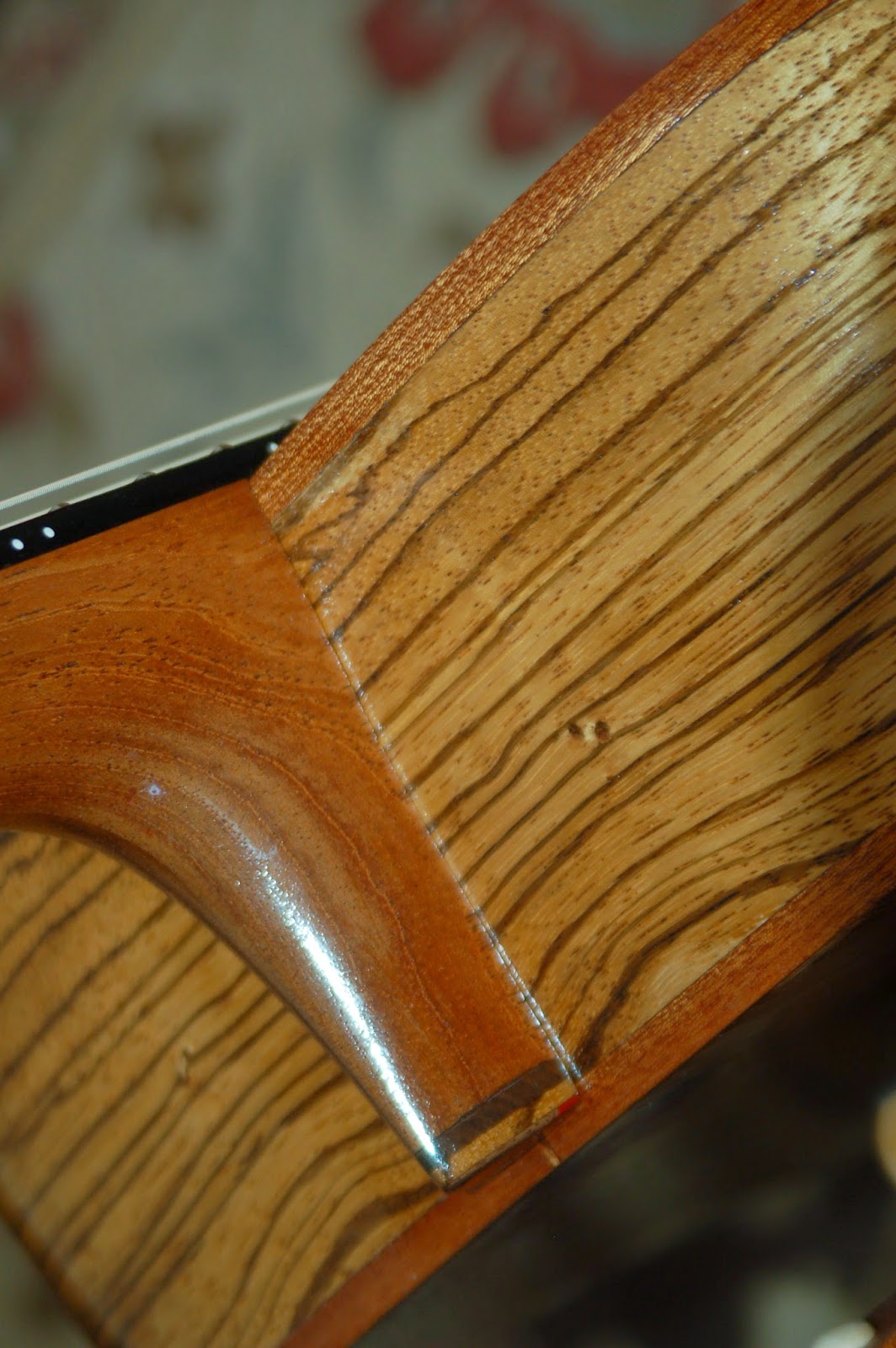
So, a smaller version of the top-heel design became the order of the day, for the tailend and for the area adjacent to the neck heel cap, which is made of three layers of wood - walnut, zebrawood and a collage of color.




When I first started in on the journey building acoustic guitars, I sought the advice and direction of a numbers of folks, who have been doing this for a long time.

 And, the one thing that 'old timers stressed as the most important aspect of all is neck angle, with respect to the body, and how closely the neck fits to the body at the joint.

 If the angle is wrong, the guitar will never play properly, and if the neck/body joint is wrong, the same is true.

 I took the advice to heart and the fit is perfect.  Thank you Pat and Dan for your guidance.

This shot of the back side of the guitar shows off the color and grain of the body, the subtlety of the inlay color, the neck volute, and the Grover tuners.


Inside the body and out of sight are some of the most important design elements.

I follow the pre-war Martin Guitar design for top and bottom braces, which I hand-formed from raw pieces Sitka spruce.

All top bracing is scalloped, and back braces are tapered.

Serrated mahogany liner around the inside edges of the sides serve as glue areas for attaching the top and back.

And, small spruce rib braces were hand formed to support and stabilize the sides.

A final 'thank you' goes to my friend David for encouraging me to step outside my comfort zone and to add more personal creativity to this creation.

I cannot wait to share with you the next build, which is on the bench waiting for me to get going.

Sunday, March 1, 2015

Sunday, February 15, 2015

'Francesca' is in the oven

After seeing my last acoustic creation ('Gabriella'), my friend David suggested that I commence to add some 'Jess stuff' to my builds.  I asked, "What might that be?"  And, David replied, "Some special personal creativity that reflects your ability.  Don't be so timid about it!"

I've given a lot of thought to what David had to say and I think he's right, I'm not as expressive with the acoustic creations as I've been with the cigar box guitars I've built.  I'm not really timid about it, just not as confident.  Perhaps because the acoustic creations are 'real' guitars, while the CBGs are less traditional and a lot more funky.

Well, 'Francesca' is in the oven and she will be a whole lot more like what David may have in mind.

To get started, I had to decide how I might approach being more expressive.  I like the dreadnought body shape, so I'm not changing that, however, there are subtle things I can do with it to add a little spice . . . I'll just have to experiment.  Because of the nature of the beast, the dreadnought is what it is, and when I start messing with the shape it's no longer what I prefer.

So, where to begin?

I decided to do something special to attract attention without major body modifications.  Thus, a unique headstock overlay design.  A sound hole rosette inlay to match the overlay.  And, a tailpiece insert that matches.

The design, according to my son Jay, is 'cubist'. Perhaps it's a reflection of what Picasso might have come up with if he was into guitars at the time he was creating art.  I'm familiar with Braque and Picasso art, but that wasn't what I had in mind when I ventured off into my creative journey.  I just wanted to produce something colorful and unique in design to accent parts of my guitar.


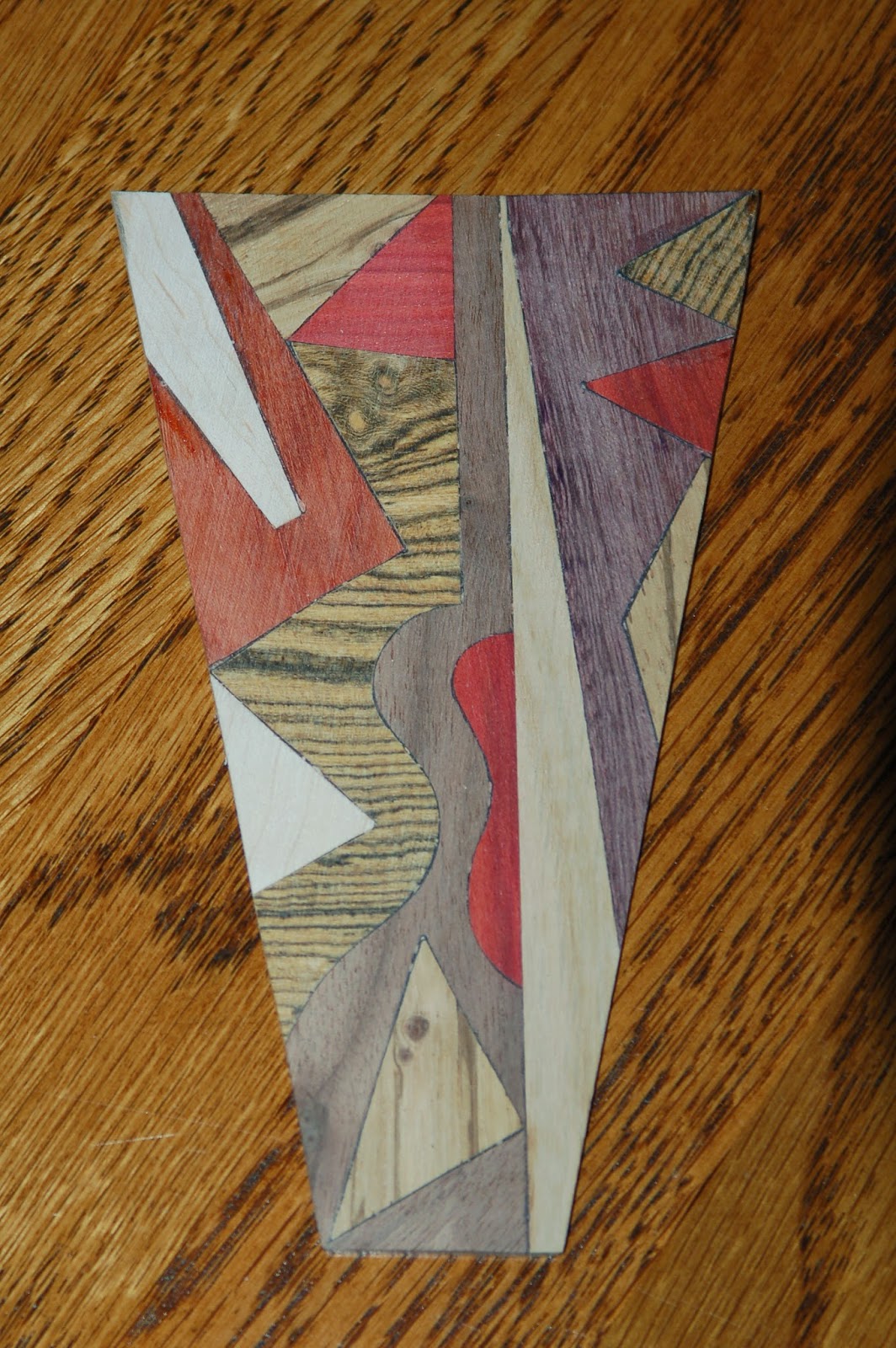
This is the headstock overlay, which is created from 21 individual pieces of exotic wood individually cut from 1/16" stock.  I worked from a pattern I drew, but decided on the specific wood choice as I moved along in the process. Each piece is glued on its edge to the adjacent piece.  You'll notice the base of the design is a stylized guitar shape in walnut. Other woods are purple heart, chatke kok, zebra wood, spruce, yellow heart, rosewood, Spanish cedar, mahogany and blood wood.

  
The sound hole rosette follows the overlay theme with 22 individual pieces glued together in the same manner as the headstock.  The trick here was to join the pieces and to cut the shape without breaking it.


Here's the tailpiece insert comprised of 16 pieces of 3/32" wood matching the overlay and rosette. This piece is slightly thicker, because it will be 'sandwiched' into an opening where the side ribs come together at the back of the guitar.  Again, you'll notice the subtle shape of a guitar as the base for the design.


Work in process.  The overlay is glued and curing, while the insert is being completed.  The drawings are my guide.

I hope Pablo doesn't mind me unintentionally intruding on his turf.

I'll post more photos as the build progresses.

Saturday, February 7, 2015

Oh, Ya, You Really Want Me To Play?


My young friend Richard contemplating what he wants to do with his new TotalRojo guitar.

Rich's grandpa and I have been friends for more years than either of us care to admit, which would probably put us in the 'old' category, but 'old' is a state of mind right?

Joe and his wife Jeri told me how Rich likes music and sings all the time, so I got to thinking about it and decided to gift a three-string guitar to Rich to get him started playing as well as singing.

Tuesday, February 3, 2015

'Angelina' and Albuquerque

The Vintage Albuquerque auction to raise funds for Children's Arts Education in Albuquerque, New Mexico has once again asked me if I would create a special guitar to be auctioned in their special event June 24 - 28, 2015.  Of course, I said yes.  If you're interested in learning more about this wonderful event, go to www.vintagealbuquerque.org.


                    In the meantime, let me introduce you to 'Angelina'.  

The basis for the 'Angelina' build is a large Riunite wine box, which I acquired a while back with no special intention in mind. But when my friend Cate Stetson asked me to create another guitar for this year's auction, I knew just what I'd do.

The size of the body shouted 'acoustic', so the basic decision was easy. However, that was only a starting point.

The neck is a one-piece mahogany 'D' style bolt-on design complete with triangle shaped volute to give it character.  A rosewood headstock overlay, Corian nut and rosewood fingerboard with pearl position markers complete this part of the package.

As we move along in the description of the build, I'll try to point out the more interesting and necessary elements that went into creating what turned out to be a really nice sounding and very playable instrument.


                                                    Grover tuning machines tension the strings.

Traditionally, acoustic guitars are made from solid pieces of wood, but when creating something special, tradition sometimes takes a back seat.  Some would argue that only traditional methods produce playable instruments, but that is not always the case.  The body of this guitar is a box made from laminated pieces of Spanish cedar, and who knows what else makes up the three layers of sheet.

We'll get to the internal parts that make this playable in a moment, but until then let me explain the top.

The bridge is rosewood with Corian saddle. The sculpted pieces at the corners are crafted from mahogany to give life to the top. You'll note that the Vintage Albuquerque logo subtly appears in the top right-hand design. The other designs have various size circular openings, which I hope you will imagine to be bubbles in the wine . . . 'tiny bubbles in my wine, tiny bubbles make me feel fine!'

The wine box itself is well constructed with dovetail joints at the corners, but to further reinforce the construction, I added 'X'-style bracing to the inside of the top and lateral bar braces to the inside of the back.


The box top was originally hinged on one side for access, with clasps on the other side to secure the lid.  But, since the body had to be one piece, I glued the top in place and eliminated the hinges, but left the clasps in place. Of course this left the hinge side looking pretty naked, so I hand carved a couple mahogany grape clusters to accent things.  The contrast in color is a little less dramatic than in the reflected light on this photo, but the idea is visible.


On the tail end of the body, I wanted to do something that would accent, while keeping with the theme, so I cut out a grape leaf shape from a piece of Rosewood to match the fingerboard and headstock overlay.

The VA logo is included in this piece as well, to further the identity of the occasion for the creation.


I chose to create a stylized New Mexico State Flag to accent the back.

The center 'sun' cutout is a piece of Spanish cedar left over from a previous build.

And, the 'rays' are thin pieces of hickory cut into the shape of wine bottles and lightly stained, for contrast with the cedar back.

I could have gone the traditional  design route for the flag, but that's not what this guitar is all about.  I built it for a special occasion and the details needed to be a bit special, too.


The neck heel cap is a piece of Leopard wood separated from the mahogany neck by a  thin piece of Sitka spruce, which adds a little detail as well.


The finish is several hand applied coats of a mixture of Linseed Oil and Turpentine, which I chose at the suggestion of my friend David.  He thought the treatment on the raw wood could work well, like it does on fine furniture . . . he is correct.  The satin effect is an 'old glow' that is perfect for a piece of modern day folk art.

I hope the folks at Vintage Albuquerque like 'Angelina', I know I do, and it will be difficult to let her go. But, I know her new owner will enjoy her.