 Wouldn't this be the perfect place to sit on the porch and play the blues?

Thursday, April 18, 2013
The Perfect Porch For The Blues


Sunday, April 14, 2013

Wednesday, April 10, 2013
Gusle Bow On Way To UK

I had created one for myself several months ago to favor the Gusle I traded for with Carlton Gill-Blyth.
Jade Buck asked me to create a similar bow using a ram's head as a design, which would match the headstock on her instrument.
 The bow is handmade from poplar wood, and the ram's horns are carved from a piece of Spanish cedar that is used for guide strips inside the cigar
boxes I use in building guitars.
Horsehair strands are the 'strings' for the bow, and it is held in place on either end of the bow by small button pegs I created from dowel material I had laying around.
I applied a little soft resin (they call it soft, but it's hard as a walnut shell) and tried it out on my Gusle. The sound is really morbid, but that is the the musical platform that makes the Gusle interesting. The instrument, which is a product of Serbia/Croatia/etc., is played to accompany story telling, which usually has to do with hardship and tragedy experienced in that culture and region of the world.
Thursday, April 4, 2013
'Darine'
I'm always scouting around for places to pick up cigar boxes and I've been fortunate enough to discover really cool off-the-beaten-path cigar shops. My friends Jeff at Burning Leaf and Ed at Woodland Cigars were willing to trade me boxes for a guitar they could display in their shops, so that helped the inventory in my shed.
While my wife and I were eating at our favorite Columbus deli, I happened to see a small ad on the front page of an entertainment tabloid, which announced the locations for House of Cigar, another cool place I discovered.
On our way, I stopped to check out the place. More really cool boxes for future CBG masterpieces, right? Well, it was more than I expected. They have outta sight cigar boxes, and after the lady behind the counter learned what I do with the treasures I pick up, she wanted me to create a guitar for her daughter.
So, here it is: An electric six-string with a Tatuaje cigar box for a body and a Fender Strat neck to stretch it out.
This is for a girl, so I wanted it to be a little less 'in your face' design. I decided on letting the original box (red color from the factory) carry the design, with simple hand striped accent. The name 'Darine' came from the woman requesting that I paint her daughter's name on the top of the body. Again, simplicity seemed to be the way to go.
A single coil magnetic pickup with on-board volume control broadcasts sound, which is about as simple as it gets.


While my wife and I were eating at our favorite Columbus deli, I happened to see a small ad on the front page of an entertainment tabloid, which announced the locations for House of Cigar, another cool place I discovered.
On our way, I stopped to check out the place. More really cool boxes for future CBG masterpieces, right? Well, it was more than I expected. They have outta sight cigar boxes, and after the lady behind the counter learned what I do with the treasures I pick up, she wanted me to create a guitar for her daughter.
So, here it is: An electric six-string with a Tatuaje cigar box for a body and a Fender Strat neck to stretch it out.
This is for a girl, so I wanted it to be a little less 'in your face' design. I decided on letting the original box (red color from the factory) carry the design, with simple hand striped accent. The name 'Darine' came from the woman requesting that I paint her daughter's name on the top of the body. Again, simplicity seemed to be the way to go.
A single coil magnetic pickup with on-board volume control broadcasts sound, which is about as simple as it gets.


'Ebony'
A couple weeks ago, I got a call from a Jimmy Barnhill in Birmingham, AL. He had bumped into my site and after seeing 'Plum Crazy' (the six-string I use for my business card logo), he just had to have it. Sorry, I said, "It's gone. But, I can create something similar." We kicked ideas around and he settled on a three-string electric with mag pickup and pinstriping on the face, and he wanted my logo as big as possible on the back.
I chose a out-of-production Tatuaje cigar box for the body (I got several of these rare creatures rat holed for future builds), because they are just the right size for a guitar and the basic design is clean and easy to work with. They're just cool looking boxes and they resonate very well.
A red oak neck with Spanish cedar lamination on the headstock kick off this little devil. The headstock is a reduced version of a Strat, so it will fit well with the overall design of the 24.5-inch scale three-string. The fretboard is oiled Ziricote wood with hand dressed stainless frets. The nut and saddle are Corian. The bridge and tailstock string retainer are hand formed Ziricote to match the fretboard. Sealed Gotoh style tuners stretch the strings to an open G tuning. And, the magnetic pickup is a hand wound number created by my friend Roger Berry of Hazelhurst, MS. The grain in the exotic Ziricote wood is magnificent, and it's very hard wood, so perfect for a fretboard.
The body is sprayed with black enamel, and the four-color pinstripe job on the face of the body is hand painted (at 72, I guess I still have a steady hand when I need it). Light and dark magenta base colors with teal outline and gold accents are complimentary and look pretty good on the black background. The logo on the back of the body is laminated onto a thin piece of maple ply, cut out on my scroll saw, and glued off the surface to give a three-dimensional effect, which I think looks pretty good.


I chose a out-of-production Tatuaje cigar box for the body (I got several of these rare creatures rat holed for future builds), because they are just the right size for a guitar and the basic design is clean and easy to work with. They're just cool looking boxes and they resonate very well.
A red oak neck with Spanish cedar lamination on the headstock kick off this little devil. The headstock is a reduced version of a Strat, so it will fit well with the overall design of the 24.5-inch scale three-string. The fretboard is oiled Ziricote wood with hand dressed stainless frets. The nut and saddle are Corian. The bridge and tailstock string retainer are hand formed Ziricote to match the fretboard. Sealed Gotoh style tuners stretch the strings to an open G tuning. And, the magnetic pickup is a hand wound number created by my friend Roger Berry of Hazelhurst, MS. The grain in the exotic Ziricote wood is magnificent, and it's very hard wood, so perfect for a fretboard.
The body is sprayed with black enamel, and the four-color pinstripe job on the face of the body is hand painted (at 72, I guess I still have a steady hand when I need it). Light and dark magenta base colors with teal outline and gold accents are complimentary and look pretty good on the black background. The logo on the back of the body is laminated onto a thin piece of maple ply, cut out on my scroll saw, and glued off the surface to give a three-dimensional effect, which I think looks pretty good.


Wednesday, April 3, 2013
Skull Pickup Design
A couple weeks ago, I sent custom wound magnetic pickups to my Irish buddy Carlton, and he was so enthusiastic about them he asked me to create a special one-of-a-kind skull design. Of course a volume pot and output jack had to be added, because Carl cannot solder without burning his fingers (so he says). q;-)
After noodling it around for a while and looking at a few illustrations, I settled on something I thought might work. The design had to look like a skull in all its horrid glory, but it had to be drawn to size so that it would accommodate the magnet posts without spoiling the overall design.
So, I chose to draw a skull with big eye sockets and a nose cavity large enough to hide the posts, but to still allow the proper string spacing locations. But, it had to look right -- sunken eye sockets, cranial cracks, elongated teeth, and a general disgusting distorted appearance. The width of the pickup is about 3", which is average, and the depth is about the same, which is greater than usual designs, but it looks great on a guitar top, so it's OK.
A bleached white skull just didn't do it for me as a cigar box guitar accessory, so I decided to stick with a dark stained wood bobbin top, which I hand painted with black accents to create the effect I think Carl was expecting. There's nothing more creepy than black eyes and nose cavities in a stylistic skull drawing. The magnet posts are hidden with the paint so as not to detract from the overall design (the paint does not distort or displace sound).
Take a look, and if you cannot live without a cool custom-designed guitar pickup at a fair price, send me a note (contact me on this site) and I'll fix you up.
.JPG)
After noodling it around for a while and looking at a few illustrations, I settled on something I thought might work. The design had to look like a skull in all its horrid glory, but it had to be drawn to size so that it would accommodate the magnet posts without spoiling the overall design.
So, I chose to draw a skull with big eye sockets and a nose cavity large enough to hide the posts, but to still allow the proper string spacing locations. But, it had to look right -- sunken eye sockets, cranial cracks, elongated teeth, and a general disgusting distorted appearance. The width of the pickup is about 3", which is average, and the depth is about the same, which is greater than usual designs, but it looks great on a guitar top, so it's OK.
A bleached white skull just didn't do it for me as a cigar box guitar accessory, so I decided to stick with a dark stained wood bobbin top, which I hand painted with black accents to create the effect I think Carl was expecting. There's nothing more creepy than black eyes and nose cavities in a stylistic skull drawing. The magnet posts are hidden with the paint so as not to detract from the overall design (the paint does not distort or displace sound).
Take a look, and if you cannot live without a cool custom-designed guitar pickup at a fair price, send me a note (contact me on this site) and I'll fix you up.
.JPG)
Thursday, March 28, 2013
Awesome Kids!
We had a heavy, wet snow - 3 inches or more - a couple weeks ago.
I was sitting around looking out the window contemplating the task at hand. Do I really want to get dressed warm and to venture out to crank up the snow blower to deal with this stuff? Snow blowers just don't move wet snow very well, and I sure as heck didn't want to shovel.
Maybe 'the guy' will come by to take care of my problem? No, 'the guy' didn't show up as usual - probably too much of a job. Wet and heavy is not as much fun for the money.
So, off I went to the coffee pot for a refill to help me make a decision. While I was loading on caffeine, I heard a soft knock at the door. Oh, no, is the door chime not working? One more thing to ruin my day.
I opened the door and saw two small kids standing up to their ankles in snow, with shovels over their shoulders. "This ain't 'the guy," I thought, unless he's shrunk and has small helper."
 Zach and Rachel, ten-year-old cousins from another street away were drumming up business in the 'hood.
Rachel, the spokesperson said, "Can we shovel your driveway?"
I said, "It's pretty long, so you better look at it and decide if you want to do this, 'cause the snow is pretty heavy and wet."
They tromped off to investigate, and on returning said, "Yes!, we want to do it."
I asked how much they charged, and after giving it serious thought, Zach said, "Fourteen dollars."
I said, "Just so we're clear, you're going to shovel 110 feet of driveway and the walks and stoop for fourteen bucks?"
"Yup," they said in unison.
"OK, we got a deal," I said. And off they went.
About an hour later, they returned, having done a great job, but looking pretty tired.
I asked, "How'd it go?"
Zach looked at me and said, "I think we should have asked for more."
I smiled and said, " I agree," and I handed Zach twenty-five bucks, saying, "You Zach, you gotta share this with Rachel," and Rachel said, "Oh, ya, we'll share!"
My final request was, "Can I take your photo, because I want to put it on my web site, to let my friends know that a couple really cool little kids live in my neighborhood?" Zach replied, "Oh, I thought it would be in the newspaper." And, I replied, "Don't worry Zach, my web site is better read."
Not all kids are tied to TV and video games, and my new friends, Zach and Rachel have demonstrated it clearly. I hope they come by to visit some time, 'cause they're 'my kinda kids.
Zach and Rachel must have some awesome parents!
I was sitting around looking out the window contemplating the task at hand. Do I really want to get dressed warm and to venture out to crank up the snow blower to deal with this stuff? Snow blowers just don't move wet snow very well, and I sure as heck didn't want to shovel.
Maybe 'the guy' will come by to take care of my problem? No, 'the guy' didn't show up as usual - probably too much of a job. Wet and heavy is not as much fun for the money.
So, off I went to the coffee pot for a refill to help me make a decision. While I was loading on caffeine, I heard a soft knock at the door. Oh, no, is the door chime not working? One more thing to ruin my day.
I opened the door and saw two small kids standing up to their ankles in snow, with shovels over their shoulders. "This ain't 'the guy," I thought, unless he's shrunk and has small helper."

Rachel, the spokesperson said, "Can we shovel your driveway?"
I said, "It's pretty long, so you better look at it and decide if you want to do this, 'cause the snow is pretty heavy and wet."
They tromped off to investigate, and on returning said, "Yes!, we want to do it."
I asked how much they charged, and after giving it serious thought, Zach said, "Fourteen dollars."
I said, "Just so we're clear, you're going to shovel 110 feet of driveway and the walks and stoop for fourteen bucks?"
"Yup," they said in unison.
"OK, we got a deal," I said. And off they went.
About an hour later, they returned, having done a great job, but looking pretty tired.
I asked, "How'd it go?"
Zach looked at me and said, "I think we should have asked for more."
I smiled and said, " I agree," and I handed Zach twenty-five bucks, saying, "You Zach, you gotta share this with Rachel," and Rachel said, "Oh, ya, we'll share!"
My final request was, "Can I take your photo, because I want to put it on my web site, to let my friends know that a couple really cool little kids live in my neighborhood?" Zach replied, "Oh, I thought it would be in the newspaper." And, I replied, "Don't worry Zach, my web site is better read."
Not all kids are tied to TV and video games, and my new friends, Zach and Rachel have demonstrated it clearly. I hope they come by to visit some time, 'cause they're 'my kinda kids.
Zach and Rachel must have some awesome parents!
Friday, March 15, 2013
Taper Jig
I was looking around the other day for a taper jig that would work with my table saw. They're available from a variety of sources ranging in price from $19.99 to $79 and change.
None of what I saw advertised rang my bell, so i decided to create my own, using sample illustrations as a springboard for my venture.
As it turned out, it was a snap to create. A couple pieces of real straight 1" x 2.5" x 24" poplar; a 1/4" piece of ply for the custom designed slip gauge; a hinge to attach the pieces of poplar; a turn-screw to lock the gauge down to a countersunk nut in the top of the anchor piece of poplar; a couple decorative craft dowels for handles; a small angle bracket bent to proper shape for an angle marker; and a small wedge-shaped stock stop glued to the leading edge to guide the material through the blade.
Voila! I gots meself a real taper jig to cut fretboards, and it cost me about $5 and a hour labor. What do you think? Perhaps this idea will work for you.

None of what I saw advertised rang my bell, so i decided to create my own, using sample illustrations as a springboard for my venture.
As it turned out, it was a snap to create. A couple pieces of real straight 1" x 2.5" x 24" poplar; a 1/4" piece of ply for the custom designed slip gauge; a hinge to attach the pieces of poplar; a turn-screw to lock the gauge down to a countersunk nut in the top of the anchor piece of poplar; a couple decorative craft dowels for handles; a small angle bracket bent to proper shape for an angle marker; and a small wedge-shaped stock stop glued to the leading edge to guide the material through the blade.
Voila! I gots meself a real taper jig to cut fretboards, and it cost me about $5 and a hour labor. What do you think? Perhaps this idea will work for you.

I'm getting set up here to cut a piece of exotic ziricote.
Once I've determined the angles I want, I'll mark the slip gauge, and any future cuts will be a snap.
Contest Results Pouring In

Thanks, everyone.
In the short time since posting the contest request asking for suggestions in re-purposing this wood violin case into something musical, numerous replies have been offered.
But, it's not over. I'll let this run for a while longer to allow others to offer suggestions.
Come on folks, put on the thinking caps and noodle the idea around, 'cause the person with the most original and workable idea is going to win a really nice 3-string guitar cigar box guitar.
Listed below are the ideas I've received so far:
- Jef Long -- A harp designed to be size appropriate to the case, but in the a traditional harp design. Jef even provided a drawing to explain his thought.
- Jonathan Greiner -- A dulcimer.
- Craig Koen -- A lap slide guitar with built-in amp.
- Roland Burghardt -- A sitar.
- Randy Bretz -- A lap steel guitar.
- Linda Potberg -- A two-sided dulcimer. One on either side of the cantilevered top. She says that in the old days this was an instrument made for courting couples to keep playing music, rather than 'playing' around.
- Humidor Guitars -- A stand up bass. Even though I had offered that possibility, I'm still going to allow for the idea to be considered.
- Rosalyn Baker -- Says it gotta be a stomp box.
- Todd Kasuboske -- 'Put a violin in it.'
- Anonymous -- A CBG with amp and harmonica mic. (Too bad there is no name)
- S. William Moody -- A bass. This suggestion will also be considered.
- S. William Moody -- A lap steel guitar with amp.
- Anonymous -- 'Use it for Tommy gun storage.'
- Anonymous -- 'Use it as a storage shelf'.
- Chris Dobbs -- A bass playable as a CBG, with antique design effects. Use the handle as a bridge. Antique brass hardware throughout. Warwick style headstock. 'And it's gotta have f-holes.'
- Kevin Gibbs -- A violin-shaped Uke with f-holes and scroll headstock.
- Baltazar Zoltar -- 'Liquor storage, or if you insist on a musical instrument, a hurdy gurdy.'
- Rik Prins -- A viola da gamba.
- Rik Prins -- A tromba marina.
- Geri Dalbec -- A very clever keyboard inside.
- Anonymous -- Fill it with 100E bank notes and send it to me.
- Rocky Tolley -- Retracting neck that comes out and forms a standing bass, but when closed it also contains a thin cigar box guitar, a nice Hohner harp, and a Jews harp, for a complete band in a case.
Tuesday, March 12, 2013
'Rare Bird'
My friend Ed Paxton, owner of Woodland Cigar Company in Delaware, Ohio, asked me to build a guitar for him. The only proviso was that it must be made from a Rare & Fine (that's the cigar brand) cigar box he would provide, which I really wanted for my own use. But, what to heck, Ed is my friend, and that came before staking a claim for the box.
The 'Rare Bird' is a four-string guitar with a scarf joint headstock with Spanish cedar lamination, walnut neck and leopardwood fretboard. The nut and saddle are hand formed from Corian, and the bridge and tailstock are leopardwood. Open back geared tuners provide tension to the D, G, B, e strings from a standard set of 10-47 ga. acoustic, which are tuned to match. The magnetic pickup is a TotalRojo design handmade with leopardwood bobbin top.
This is a very simple and straight forward build to accentuate the beautiful box. I added small latches to the side to keep the box closed, since it comes without the usual snap tabs, but that's it,other than an output jack and strap button on the back end.


The 'Rare Bird' is a four-string guitar with a scarf joint headstock with Spanish cedar lamination, walnut neck and leopardwood fretboard. The nut and saddle are hand formed from Corian, and the bridge and tailstock are leopardwood. Open back geared tuners provide tension to the D, G, B, e strings from a standard set of 10-47 ga. acoustic, which are tuned to match. The magnetic pickup is a TotalRojo design handmade with leopardwood bobbin top.
This is a very simple and straight forward build to accentuate the beautiful box. I added small latches to the side to keep the box closed, since it comes without the usual snap tabs, but that's it,other than an output jack and strap button on the back end.


Monday, March 11, 2013
Give Me An Idea, and Win A Guitar!
A while back, I posted photos of a couple TotalRojo pickups I designed and created for my friend Carl, the wild man from Ireland, who traded me a wood violin case. Well, here it is in all it's aging beauty.


I'm not sure what I'll do with it, but some ideas have come to mind.
What do you think about a stand-up base, small of course, built to match the size of the box. Add a nice walnut neck with coco bola fretboard, fancy headstock, a shaped floor peg, a few strings, and it can be a real bass rig.
Or, it could become the home for a Ukulele in the shape of a Thompson submachinegun, ala Al Capone era fun tools.
How 'bout a multi-speaker amp to blow sound around the shed, while I'm busting out custom guitar orders.
But, I bet some of you readers out there have just the right idea for this little fella!

So, share your thoughts with me here on my site, and . . . I'll gift the provider of the best idea with a custom built three-string cigar box guitar.
That's right, you're not imagining anything. Come up with the best idea for the re-purposing of the violin case, and I will give you a custom made guitar.
Come on now, I know you got some great ideas.
Wednesday, February 13, 2013
Handmade Pickups Go To Ireland
My friend Carlton wrote me a while back offering to trade an old wood violin case for a couple hand wound pickups for future CBG builds he has on the board.
I never know what to expect when the Irish lad makes me an offer, but one thing for sure whatever he offers is going to be really cool.
The case (I don't have a photo yet to share, but it's coming, so stay tuned) is really old, weather beaten, a little banged up, but it's going to make a great 'something'. I have a notion to turn it into a mini stand up bass, but then again, I've been thinking about a really cool uke in the form of a 20's-era Thompson sub-machine-gun design . . . wouldn't that look super in the violin case . . . eat your heart out Capone.
Carl gave me a sales pitch about how he is crappy at soldering and begged me to make pickups complete with volume controls and output jacks, so I caved in to satisfy the lad. After all, he's a great guy and a helluva lot bigger than me.

The pup on the left is made from coconut palm wood and the other is coca bola. I like the look of the exotic woods, and they're nice to work with. Most that I choose are quite dense and hard, but they finish out well. These particular pups are top mount, but I also create flush mount units as well.
If you would like a nice handmade pickup for your special build, let me know and I will try to work with you. Three-string pups are $25, and with volume pot and jack it's $35. Add $10 for a four-string version.
I never know what to expect when the Irish lad makes me an offer, but one thing for sure whatever he offers is going to be really cool.
The case (I don't have a photo yet to share, but it's coming, so stay tuned) is really old, weather beaten, a little banged up, but it's going to make a great 'something'. I have a notion to turn it into a mini stand up bass, but then again, I've been thinking about a really cool uke in the form of a 20's-era Thompson sub-machine-gun design . . . wouldn't that look super in the violin case . . . eat your heart out Capone.
Carl gave me a sales pitch about how he is crappy at soldering and begged me to make pickups complete with volume controls and output jacks, so I caved in to satisfy the lad. After all, he's a great guy and a helluva lot bigger than me.

The pup on the left is made from coconut palm wood and the other is coca bola. I like the look of the exotic woods, and they're nice to work with. Most that I choose are quite dense and hard, but they finish out well. These particular pups are top mount, but I also create flush mount units as well.
If you would like a nice handmade pickup for your special build, let me know and I will try to work with you. Three-string pups are $25, and with volume pot and jack it's $35. Add $10 for a four-string version.
Wednesday, January 16, 2013
'Piano Man' Project
I've not posted anything for a while, because I was invited to participate in a 'piano man' project, which has taken some time to complete.
It's a really funky art project idea developed by Ken Arthur, a local artist, who selects other artists to work with specific pieces to create individual examples for him to display in various art exhibits around the country.
Ken creates a 'piano man' with parts captured from junk pianos. Pieces from two standard pianos and one baby grand are required to make a single piano man, but there are obviously numerous little creatures to be made from the many pieces in each of the pianos. Ken assembles the captured parts in a manner that resembles a human anatomy (take a look at the raw example in the pic below), and then the fun begins. The only requirement for the project is that the 'piano man' be kept intact, but it can be arranged in any creative manner or theme to fit inside a shadow box approximately 4" x 10" x 16".
Each artist is provided with two separate 'men' and boxes, from which Ken selects one for his traveling show, and the artist keeps the other . . . that's the only stipulation for participation.
I chose to create a 'Bluesman' (ala Ground Zero Blues Club featuring James 'Super Chikan' Johnson, who regularly plays at the club) for one of my projects, and the other is a 'Newsie' (late 1800s newspaper delivery boy). Ken hasn't had the opportunity to make his selection yet, so it remains to be determined which will make the art exhibit . . . maybe both, if I decide to let him have each of them . . .
Project start


It's a really funky art project idea developed by Ken Arthur, a local artist, who selects other artists to work with specific pieces to create individual examples for him to display in various art exhibits around the country.
Ken creates a 'piano man' with parts captured from junk pianos. Pieces from two standard pianos and one baby grand are required to make a single piano man, but there are obviously numerous little creatures to be made from the many pieces in each of the pianos. Ken assembles the captured parts in a manner that resembles a human anatomy (take a look at the raw example in the pic below), and then the fun begins. The only requirement for the project is that the 'piano man' be kept intact, but it can be arranged in any creative manner or theme to fit inside a shadow box approximately 4" x 10" x 16".
Each artist is provided with two separate 'men' and boxes, from which Ken selects one for his traveling show, and the artist keeps the other . . . that's the only stipulation for participation.
I chose to create a 'Bluesman' (ala Ground Zero Blues Club featuring James 'Super Chikan' Johnson, who regularly plays at the club) for one of my projects, and the other is a 'Newsie' (late 1800s newspaper delivery boy). Ken hasn't had the opportunity to make his selection yet, so it remains to be determined which will make the art exhibit . . . maybe both, if I decide to let him have each of them . . .
Project start


'Bluesman'


'Newsie'


Photo Collage


The 'Bluesman' is a collage of photos I took at the the club, and a collection of other photos gathered along the way in the creation of the project. Many of the photos are laminated on thin wood and cut to give the effect of the real deal in miniature. The red guitar is hand carved to reflect the style with which 'Super Chikan' creates the guitars he plays on the road and in the club.
The 'Newsie' box is decorated with articles torn from a 1936 newspaper, which I sacrificed for this project, and very old photos of early 1900s 'newsies' on the streets of New York, Boston, San Francisco, Chicago, and other cities.
Now, it's time to get back in the shop to turn out guitars for a mid-March annual gala at the Woodland Cigar store in Delaware.


Photo Collage


The 'Bluesman' is a collage of photos I took at the the club, and a collection of other photos gathered along the way in the creation of the project. Many of the photos are laminated on thin wood and cut to give the effect of the real deal in miniature. The red guitar is hand carved to reflect the style with which 'Super Chikan' creates the guitars he plays on the road and in the club.
The 'Newsie' box is decorated with articles torn from a 1936 newspaper, which I sacrificed for this project, and very old photos of early 1900s 'newsies' on the streets of New York, Boston, San Francisco, Chicago, and other cities.
Now, it's time to get back in the shop to turn out guitars for a mid-March annual gala at the Woodland Cigar store in Delaware.

Saturday, December 22, 2012
'The Drifter' Is On The Way To New Mexico

'The Drifter', a three-string electro/acoustic cigar box guitar is on its way to a new home in Carlsbad , New Mexico.
I got a call a couple weeks ago from a fella to ask if I would build a guitar like the 'Revelator', which is resting in the hands of Carlton Gill-Blyth in Ireland.
The basis of the guitar is an Arturo Fuente Queen B cigar box for a body. The neck is walnut with a seven degree scarf joint to slant the stylized headstock just enough for proper string alignment tension at the Corian nut. A maple fingerboard with 21 hand set frets finishes off the neck.
 Accenting the area above the open-back geared tuners on the headstock is a new issue US New Mexico quarter coin, which I thought would be proper given the intended destination, and the guitar will always be worth at least two-bits.
To push sound around, I chose to recess a paint can lid into the top for the resonator, topped with a floating bisquet bridge made of laminated Spanish cedar, maple and coconut palm, on which a Corian saddle rests. Two screen-backed nickle sound hole covers let acoustics out of the box, and if that isn't enough to scare the dogs off, a coconut palm-topped TotalRojo hand wound magnetic pickup complete with box-mounted volume control can take over through an amp, which will definitely get rid of any stray critters. The tailpiece used to anchor the strings is a simple stainless door strike, which lends itself to the clean and sanitary style of the top. Added nickle corner covers on box top and bottom completes the design and protects the body.
But what about the back, you might ask?


Well, a little web surfing and the attached art became the choice to set this guitar apart from others, since I build no two alike.
There are a couple other little nuances that make this build complete -- a custom Spanish cedar output jack surround, a custom knob for the volume pot, and a custom cedar neck pocket cover.
Friday, November 23, 2012
'Sweetness'
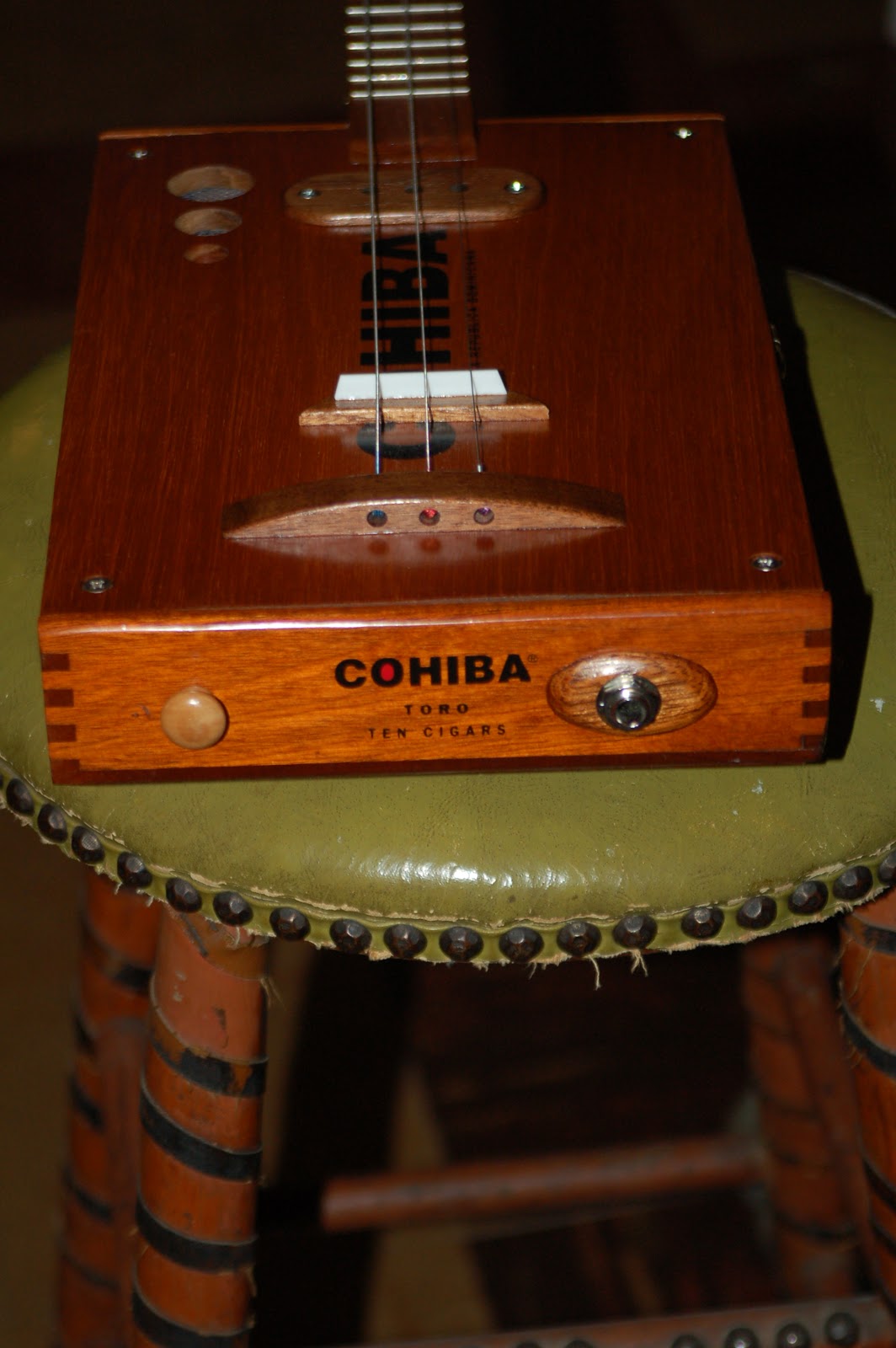
I like Cohiba cigar boxes, because they are simple in design and work so well for cigar box guitars. The box is constructed from Spanish cedar, which produces a rich, warm sound, and because of the simplicity of design, they look so good after being completed.
Take a look at the simplicity of 'Sweetness', which came off my bench today, and let me know what you think.

It's a three-string electro/acoustic cigar box guitar. The full-fretted neck is walnut with scarf joint and cherry fingerboard. I decided on a simple headstock to add to the overall simplicity of the design, and to accommodate the open-gear tuners. The nut and saddle are each created from Corian, while the bridge is Spanish cedar, and the string retainer tailpiece is walnut with recessed cavities for the string ends to hide. The output jack surround is a simple design made from Spanish cedar and the strap buttons are maple doohickeys picked up at a hobby store. Three graduated sound holes with screen backing transmit acoustic sound, while the magnetic pickup is the first attempt at a TotalRojo 'Mojo' pickup (see previous post). Volume is controlled by an out-of-the-way switch at the top of the box near the neck. Several coats of Poly finish off the surfaces, and a little guitar polish makes it easy to move around the neck.


Take a look at the simplicity of 'Sweetness', which came off my bench today, and let me know what you think.

It's a three-string electro/acoustic cigar box guitar. The full-fretted neck is walnut with scarf joint and cherry fingerboard. I decided on a simple headstock to add to the overall simplicity of the design, and to accommodate the open-gear tuners. The nut and saddle are each created from Corian, while the bridge is Spanish cedar, and the string retainer tailpiece is walnut with recessed cavities for the string ends to hide. The output jack surround is a simple design made from Spanish cedar and the strap buttons are maple doohickeys picked up at a hobby store. Three graduated sound holes with screen backing transmit acoustic sound, while the magnetic pickup is the first attempt at a TotalRojo 'Mojo' pickup (see previous post). Volume is controlled by an out-of-the-way switch at the top of the box near the neck. Several coats of Poly finish off the surfaces, and a little guitar polish makes it easy to move around the neck.

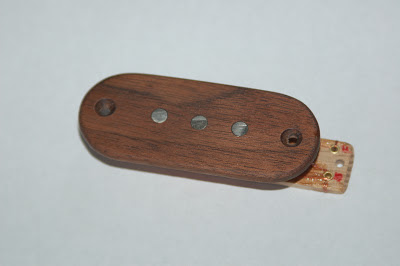
The First Custom TotalRojo Guitar Pickup
Finally, I cleared my bench and was ready to attack the project of creating my first guitar pickup. Several weeks ago, I had transformed my antique treadle sewing machine into a pickup coil winder (prior post), but there were still some critical things to accomplish.
First, I had to acquire magnetic coil wire, and that problem was solved with a little searching around town. A local electronics shop didn't have the recommended 42/43 ga. wire, readily available through supplier Stewart McDonald at nearly $35 a pound (and gas is expensive you say!), but they had a five-pound spool of 39 ga. Well, I thought, if 42 ga. will work, why not 39 gauge? So, I called StewMac for help, and the guy I talked to said, "Sure it will work, you just will need less wraps of wire on the bobbin to reach the required resistance. Wow, $45 later, I was in the wire business (5 pounds no less!).
I had already located steel pegs for the pickup posts through a supplier that didn't charge an arm and a leg just because it was for a guitar. And, I found another source for inexpensive two-conductor shielded wire to attach the pickup to volume/tone controls and output jack. Why, I wonder, is the same stuff so expensive when it is supplied by a guitar shop?
Now, it was time to design a bobbin (that's the basis for a pickup).
How do I know this stuff? I research everything, and ask a lot of questions of the guys who have already made the mistakes. Thanks Roger, Ted, StewMac, and the web location 'Instructables'.
I decided on a simple design for my TotalRojo guitar pickups, and created a template for three- and four-string versions. I like simple, because it fits my design ideas better. But, I also like the designs that others do as well.
After selecting the wood for the top and bottom of the bobbin, I drilled holes for the posts (this has to be precise, because post alignment is critical) and metal grommets, where the coil wire and lead wires are soldered after completion of the winding. The posts were super glued to the openings in the top and bottom pieces. The very fine magnetic wire was threaded through the 'start' grommet, and the bobbin attached with double sided tape to the wheel on the winder. I wrapped the first few revolutions by hand, and then it was time to let the motor turn the wheel, thus winding the coil. I turned the speed-controlled motor on and started winding the coil, while carefully feeding the hair-fine wire onto the bobbin. I wanted a warm sound from the pickup, so I chose to experiment with 7,000 wraps on the bobbin (a suggestion from the guy at Stewey). The tail of the wire was inserted into the 'finish' grommet and wound several times to hold it in place. I then lacquered over the wires to hold them firmly to the bobbin bottom.

 Everything went well, and after a short time, I had a wound pickup. The rest was easy. Solder lead wires into correct grommets, coat the coil with lacquer, wrap the coil with protective tape, attach volume pot and output jack, and test it.
Voila! It works! And, it sounds good.
I will now tweek the design and construction to make for a really sanitary finished product, but I am very happy with the first effort.
First, I had to acquire magnetic coil wire, and that problem was solved with a little searching around town. A local electronics shop didn't have the recommended 42/43 ga. wire, readily available through supplier Stewart McDonald at nearly $35 a pound (and gas is expensive you say!), but they had a five-pound spool of 39 ga. Well, I thought, if 42 ga. will work, why not 39 gauge? So, I called StewMac for help, and the guy I talked to said, "Sure it will work, you just will need less wraps of wire on the bobbin to reach the required resistance. Wow, $45 later, I was in the wire business (5 pounds no less!).
I had already located steel pegs for the pickup posts through a supplier that didn't charge an arm and a leg just because it was for a guitar. And, I found another source for inexpensive two-conductor shielded wire to attach the pickup to volume/tone controls and output jack. Why, I wonder, is the same stuff so expensive when it is supplied by a guitar shop?
Now, it was time to design a bobbin (that's the basis for a pickup).

How do I know this stuff? I research everything, and ask a lot of questions of the guys who have already made the mistakes. Thanks Roger, Ted, StewMac, and the web location 'Instructables'.
I decided on a simple design for my TotalRojo guitar pickups, and created a template for three- and four-string versions. I like simple, because it fits my design ideas better. But, I also like the designs that others do as well.
After selecting the wood for the top and bottom of the bobbin, I drilled holes for the posts (this has to be precise, because post alignment is critical) and metal grommets, where the coil wire and lead wires are soldered after completion of the winding. The posts were super glued to the openings in the top and bottom pieces. The very fine magnetic wire was threaded through the 'start' grommet, and the bobbin attached with double sided tape to the wheel on the winder. I wrapped the first few revolutions by hand, and then it was time to let the motor turn the wheel, thus winding the coil. I turned the speed-controlled motor on and started winding the coil, while carefully feeding the hair-fine wire onto the bobbin. I wanted a warm sound from the pickup, so I chose to experiment with 7,000 wraps on the bobbin (a suggestion from the guy at Stewey). The tail of the wire was inserted into the 'finish' grommet and wound several times to hold it in place. I then lacquered over the wires to hold them firmly to the bobbin bottom.


Voila! It works! And, it sounds good.
I will now tweek the design and construction to make for a really sanitary finished product, but I am very happy with the first effort.
Saturday, November 17, 2012
The 'Delta King'

The "Delta King' is the latest creation coming out of my shed yesterday. As you can see, it's a six-string electric with Tele controls. The name comes from my visit a month ago to the Mississippi delta and to deliver a guitar case and guitar to my friend Roger Berry. The cigar box is an Arturo Fuente 'King'. Thus the name 'Delta King'.
So, with the formalities out of the way, let me explain the concept of this axe. Roger sent me off on my way home to enjoy everything the delta had to offer (read about that in a previous post here) with my car loaded down with a huge treasure chest of goodies he had boxed up for me.
From the massive bounty, I chose the parts necessary to complete this build. The neck is a new Warmuth made for Fender to their specs, but it looks a little different, because I removed the dark brown finish from it to reveal the grain. The neck and bridge pickups, along with the switch and volume/tone controls, are from a Telecaster. Add a couple strap buttons and an output jack I had in my own supplies, and brass corner covers and things are taking shape.

After deciding where I wanted the bridge and pickups located, it was only a matter of measuring to determine the neck position. The box was reinforced internally for structure and balance, and control locations were decided to allow for comfortable use. Now, it was time to start putting all this stuff together.
I like the AF box, because it is covered with really cool gold colored paper accents and colorful pieces to enhance each end. But, the box is wood, not the cardboard that many of the paper covered boxes are made from. I decided on a custom design for the neck pickup surround, rather than to just cut a naked hole in the box top, and the black paint blends nicely with the color of the box. But, there is still some work to do, and some fun to be had.

I decided the guitar would not be complete without delta images, so I chose some of Roger's favorites that he had me include in the case I built for him. These are all the 'real deal' of the delta.
Top left is a tribute to Robert Johnson (the king of the delta blues movement more than a hundred years ago, and he just happens to have born at Hazlehurst, where Roger lives). Top right is T Model Ford, a well known delta blues man; then moving on down the collage is the 49/61 Crossroads sign in Clarksdale, the home of Ike Turner and Sam cooke, to name just a couple; the Po Monkey's Juke Joint outside Merigold is one of a few jukes to last into the 21st century, and it rocks every Thursday night; Club Ebony, B.B. King's juke at Indianola; Blue Front Cafe at Bentonia; The bluesman James 'Super Chicken' Johnson playing one of his signature custom made gas can guitars - he lives in Clarksdale and is a regular on the schedule at Ground Zero; a plantation cotton field somewhere in the old delta when cotton was picked by hand; and to anchor the photo collage is the Ground Zero Blues Club at Clarksdale, which is owned by Morgan Freeman and a guy from Las Vegas.
Thursday, November 8, 2012
No Assembly Line For Me!
I appreciate the need for assembly line work, and for those who have the patience for it. But I learned this past week that it is not for me.
The annual Art Center Holiday Fair is around the corner and they asked that I once again participate, to the tune of displaying for sale, fifteen guitars.
Cruising around my shop and basement rec room, I discovered that I didn't have that many guitars that I wanted to part with. I've given a bunch away and sold others, so I had to get my butt moving.
I needed to build five guitars in one week, which under normal circumstances would take me about four weeks . . . design necks, headstocks, bodies . . . round up parts . . . measure, cut, slot fingerboards for frets, drill, sand, glue, sand more, apply finish, and install hardware . . . tune, and finally make sure they play well.
"How in hell am I going to do this", I asked myself? Myself said, "Well, I guess it's time to try the assembly line venture that so many of the guys I know are able to accomplish."
I scratched my head until it bled. This isn't how I do things. But, I don't have a choice, I spent too much time recently doing fun stuff, like building a case for Roger, carving six-string guitars, and playing with my new pickup winder.
Got my crap together, literally and figuratively, and away I went --- same neck designs; fret slots cut directly into the necks; same style frets and tuners; same design for nuts, saddles and bridges; similar style cigar boxes.
When the dust settled, I had created five really cool three-string guitars.

I'm happy with the results of the effort, and I will price them to sell at the art fair, because they really are cool.
But, the assembly line routine is not for me. I don't have the desire nor patience for stuffing round pegs in square holes. And, I cannot, for the life of me, come to understand how the other guys do it. But, I've seen some of the 'fast track' creations and they're not what I will ever turn out of my shed.
The annual Art Center Holiday Fair is around the corner and they asked that I once again participate, to the tune of displaying for sale, fifteen guitars.
Cruising around my shop and basement rec room, I discovered that I didn't have that many guitars that I wanted to part with. I've given a bunch away and sold others, so I had to get my butt moving.
I needed to build five guitars in one week, which under normal circumstances would take me about four weeks . . . design necks, headstocks, bodies . . . round up parts . . . measure, cut, slot fingerboards for frets, drill, sand, glue, sand more, apply finish, and install hardware . . . tune, and finally make sure they play well.
"How in hell am I going to do this", I asked myself? Myself said, "Well, I guess it's time to try the assembly line venture that so many of the guys I know are able to accomplish."
I scratched my head until it bled. This isn't how I do things. But, I don't have a choice, I spent too much time recently doing fun stuff, like building a case for Roger, carving six-string guitars, and playing with my new pickup winder.
Got my crap together, literally and figuratively, and away I went --- same neck designs; fret slots cut directly into the necks; same style frets and tuners; same design for nuts, saddles and bridges; similar style cigar boxes.
When the dust settled, I had created five really cool three-string guitars.

I'm happy with the results of the effort, and I will price them to sell at the art fair, because they really are cool.
But, the assembly line routine is not for me. I don't have the desire nor patience for stuffing round pegs in square holes. And, I cannot, for the life of me, come to understand how the other guys do it. But, I've seen some of the 'fast track' creations and they're not what I will ever turn out of my shed.
Monday, October 29, 2012
Exotic Wood
This place is, without exaggeration, the coolest lumber/hardware store I've ever been to, and I've been to a lot of lumber yards in my 70+ years. The interior is beyond imagination. Every part of this store is finished in the finest of wood, and fixture.
Finding a source for exotic wood in small quantities, at affordable prices, is not an easily accomplished task. But, the other day a friend was telling me about a lumber yard nearby that 'has everything' a guy would want, including exotic wood.
 The place turned out to be Keim Lumber Company located in the heart of Ohio Amish country at Charm, Ohio. It's only 50 miles from me, which is a short distance considering the wide-open spaces of central Ohio.
  Keim Lumber is promoted to be more than 100 years old, and it probably is, but you wouldn't know it from the magnificent building and surrounding property, which includes a kiln, lumber storage, and other parts of the facility, not to mention there is a restaurant on the upper level inside the main building. The displays are massive and go on forever . . . including the area of most interest to me.
After gawking around for the first few minutes to get my bearings, I headed for the information desk to ask directions to the purported 'exotic wood' section. This young Amish guy (everyone working there is Amish) behind the desk said, "Let me show you. Is there anything in particular you're interested in?" I said, "Ya, wood for guitar fingerboards." He said, "You've come to the right place. We have ready-cut fingerboard stock, acoustic body stock, and electric guitar blanks, and in standard wood choices and many different exotic woods as well. And, we also have small pieces of every wood type for those craft projects."
Without boring you with further details, I'll just say that I've been back to the store several times, to quench my thirst for rosewood, cocobola, leopardwood, coconut palm, zebrawood, and numerous other varieties. And, the great thing about this is that it's available close to home at reasonable prices . . . except for ebony . . . and, that costs a fortune.
Saturday, October 27, 2012
Stella At The Swap Meet
This morning was the required trek to the monthly swap meet . . . rainy, cold, and generally not a good day for a swap. But, lo-and-behold, I ventured in to see a regular swapper who always shows up with musical instruments, and what did he have, a Stella guitar in incredibly good condition. We haggled a while about price and I finally walked out with this little jewel. It's in great condition with no fret ware, no backside scuffs, a little wear on the lower bout, original tuners needed to be oiled is all, original strings need to be replaced, and it needs a thorough cleaning and polishing. Action is about 1/8th inch at the twelfth fret, neck is straight, body is solid, with none of the expected problems with a guitar fifty plus years old. Take a look at this fare maiden that plays really well.


Thursday, October 25, 2012
What In Hell Is A Pickup Winder?
This morning I got a message from Jeri, the wife of my old friend Joe. After reading my latest blog post, she didn't understand what a pickup winder is.
I explained, first of all, that it is not a Saturday night get-acquainted line at a Miles City watering hole for the purpose of satisfying one's thirst for companionship, thus pickup, as in the opposite sex . . . oh, goodness, did I say sex? . . . see, how confused a person can become, when discussing a pickup.
Perhaps I should have written a better explanation. So, here goes.
Wikipedia -- A magnetic pickup consists of a permanent magnet with a core of material such as alnico or ceramic, wrapped with a coil of several thousand turns of fine enameled copper wire. The pickup is most often mounted on the body of the instrument, but can be attached to the bridge, neck and/or pickguard, as on many electro-acoustic archtop jazz guitars and string basses. The vibration of the nearby soft-magnetic strings modulates the magnetic flux linking the coil, thereby inducing an alternating current through the coil of wire. This signal is then carried to amplification or recording equipment via a cable. There may also be an internal preamplifier stage between the pickup and cable. More generally, the pickup operation can be described using the concept of a magnetic circuit, in which the motion of the string varies the magnetic reluctance in the circuit created by the permanent magnet.
A 'pickup winder' is the mechanism which wraps the magnet wire around the posts to create the 'pickup'.
OK, Jeri, still confused? Stay away from the watering hole, until further notice!

I explained, first of all, that it is not a Saturday night get-acquainted line at a Miles City watering hole for the purpose of satisfying one's thirst for companionship, thus pickup, as in the opposite sex . . . oh, goodness, did I say sex? . . . see, how confused a person can become, when discussing a pickup.
Perhaps I should have written a better explanation. So, here goes.
Wikipedia -- A magnetic pickup consists of a permanent magnet with a core of material such as alnico or ceramic, wrapped with a coil of several thousand turns of fine enameled copper wire. The pickup is most often mounted on the body of the instrument, but can be attached to the bridge, neck and/or pickguard, as on many electro-acoustic archtop jazz guitars and string basses. The vibration of the nearby soft-magnetic strings modulates the magnetic flux linking the coil, thereby inducing an alternating current through the coil of wire. This signal is then carried to amplification or recording equipment via a cable. There may also be an internal preamplifier stage between the pickup and cable. More generally, the pickup operation can be described using the concept of a magnetic circuit, in which the motion of the string varies the magnetic reluctance in the circuit created by the permanent magnet.
A 'pickup winder' is the mechanism which wraps the magnet wire around the posts to create the 'pickup'.
OK, Jeri, still confused? Stay away from the watering hole, until further notice!
Subscribe to:
Posts (Atom)